
Wright Brothers images for school reports, research, and educational use — 52 authentic public-domain photographs of Wilbur and Orville Wright, the 1903 Wright Flyer, their gliders, and the national memorial at Kill Devil Hills, North Carolina. Every photo here is verified from the Library of Congress, NASA, and the U.S. National Park Service. Free to download. Free to share.
Wright Brothers images for school reports — 52 authentic public-domain photographs from the Library of Congress, NASA, and the National Park Service documenting the birth of aviation. Free for students, teachers, and researchers.
📚 Doing a school report?
All images are in the public domain — free for school reports, essays, websites, and projects. For your bibliography, credit “Library of Congress, Prints and Photographs Division” or “Wikimedia Commons” along with the photographer (often the Wright Brothers themselves).
Click any image to view it full-size with details.
Every photo here comes from verified historical collections. Primary sources include the Library of Congress Wright Brothers Negatives Collection, the San Diego Air and Space Museum Archive, the U.S. National Park Service, and Wikimedia Commons. Need more context for your school report? Read our Wright Brothers Timeline, Kitty Hawk vs. Kill Devil Hills, and Ohio vs. North Carolina: Who Is the Birthplace of Aviation?
Every photo here comes from verified historical collections. Many were taken by the Wrights themselves using a glass-plate camera. Need more context? Read our companion pages: Wright Brothers Timeline 1867–1948, Kitty Hawk vs. Kill Devil Hills, and Ohio vs. North Carolina: Who Is the Birthplace of Aviation?
Who Were the Wright Brothers?
These Wright Brothers images include 52 authentic public-domain photographs of Wilbur and Orville Wright, the 1903 Wright Flyer, their gliders, the Dayton workshop, and the national memorial. Wilbur Wright (1867–1912) and Orville Wright (1871–1948) were two American brothers from Dayton, Ohio who built and flew the world’s first powered, controlled, heavier-than-air aircraft. On December 17, 1903, at Kill Devil Hills, North Carolina, Orville flew the Wright Flyer for 12 seconds across 120 feet of sand. That short hop changed everything.
Below you’ll find Wright Brothers images organized into nine themed galleries — from the first powered flight on December 17, 1903, to the granite memorial on Kill Devil Hill. Every photo is free to download, share, and reprint for school reports.
The brothers were not trained scientists. They ran a bicycle shop in Dayton, where they taught themselves engineering, aerodynamics, and machine work. Between 1899 and 1905 they built kites, three full-size gliders, and four powered aircraft. They tested over 200 wing shapes in a homemade wind tunnel. They invented a system called three-axis control — using roll, pitch, and yaw together — that every airplane in the world still uses today.
Wilbur died of typhoid fever in 1912, only nine years after the first flight. Orville lived another 36 years and saw the world go from one shaky 12-second hop to jet aircraft breaking the sound barrier. He died in 1948.
The 52 photographs on this page show the brothers, their machines, their workshop, their family, and the memorial built in their honor. Every image is in the public domain — meaning students, teachers, and researchers can use them freely for school reports, websites, books, and presentations. No permission needed. No copyright fee. Just credit the source.
Why These Wright Brothers Images Matter
They solved control
Look closely at the Wright Brothers images on this page: many show wings flexing in mid-air. Other inventors built machines that flew briefly, but none could be steered. The Wrights cracked the puzzle of three-axis control — banking, pitching, and turning — by watching how buzzards adjusted their wingtips. That insight became the foundation of every aircraft built since.
They tested everything
Most inventors of the day relied on guesswork. The Wrights built a wind tunnel in their bike shop and measured more than 200 wing shapes. Their data tables were so accurate that aerospace engineers still cite them today.
They built their own engine
No car engine in 1903 was light enough or powerful enough. Their mechanic, Charlie Taylor, built a custom four-cylinder gasoline engine in just six weeks. It produced 12 horsepower and weighed only 180 pounds.
They picked the perfect spot
The Wrights chose Kitty Hawk and Kill Devil Hills on North Carolina’s Outer Banks because the U.S. Weather Bureau ranked it among the windiest places in the country. Steady winds, soft sand, and few trees gave them the conditions they needed. Learn more in our Kitty Hawk vs. Kill Devil Hills guide.
They patented the airplane
U.S. Patent 821,393 was granted to the Wrights in 1906. It described the system of warping wings to control roll. The patent led to years of court battles with rival inventors like Glenn Curtiss.
They were honored at the spot
You can see the memorial in many of the Wright Brothers images above. In 1932, Congress built a 60-foot granite tower atop Kill Devil Hill — the same dune the brothers used to launch their gliders. Today the Wright Brothers National Memorial draws over half a million visitors a year.
The First Powered Flight — December 17, 1903 8 photos
On a cold, windy Thursday on the dunes of Kill Devil Hills, North Carolina, Orville and Wilbur Wright made four flights in their 1903 Flyer. Most of these photos were taken by the brothers themselves using a glass-plate camera.


The Glider Years — 1900–1902 6 photos
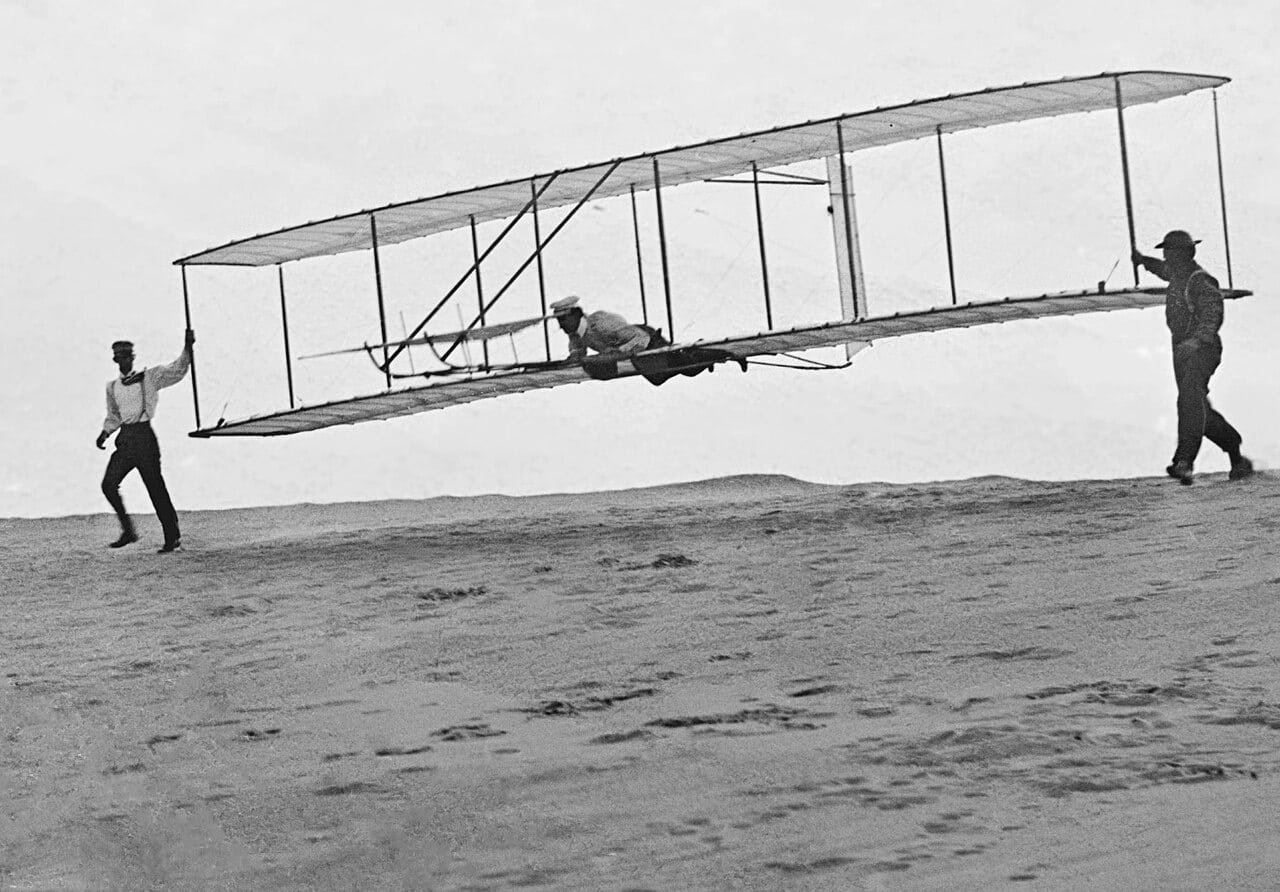
Before they ever attached an engine to a wing, the Wrights spent three summers flying gliders at Kitty Hawk. The 1902 glider was their breakthrough: it had three-axis control, the principle every modern airplane still uses.



Wright Brothers National Memorial 13 photos
In 1932, the United States dedicated the Wright Brothers National Memorial at Kill Devil Hills — a 60-foot granite pylon atop the dune where the brothers tested their gliders. The site preserves the exact takeoff point and landing markers from December 17, 1903.


Portraits of Wilbur and Orville 4 photos
Two self-taught brothers from Dayton, Ohio. Wilbur (1867–1912) was the elder; Orville (1871–1948) flew the historic first flight.


Dayton, Ohio — The Workshop 7 photos
The Wrights designed and built their aircraft in their Dayton bicycle shop. Huffman Prairie outside Dayton is where they perfected the 1905 Flyer III — the world’s first practical airplane.


Going Public — Fort Myer and Europe, 1908 4 photos
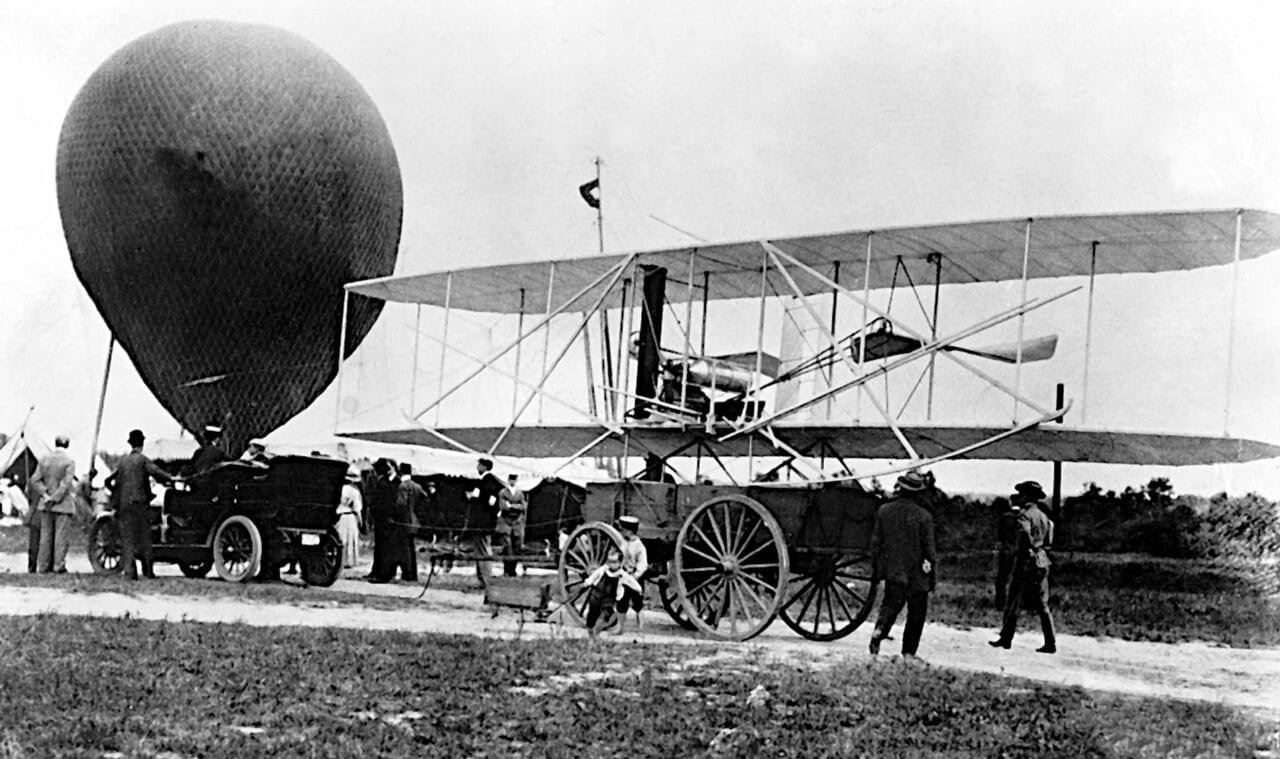
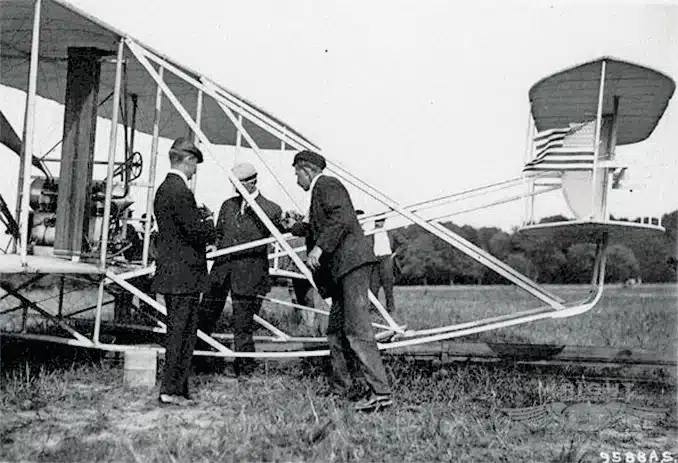
For five years after 1903, the brothers worked in obscurity. Then in 1908 they finally went public — Wilbur in France and Orville at Fort Myer, Virginia — and stunned the world.


Family, Home, and Final Resting Place 5 photos
The Wright story is also a family story — their schoolteacher sister Katharine, the Dayton family home, the Hawthorn Hill mansion, and the family plot in Woodland Cemetery.


Engines, Propellers, and the Wind Tunnel 4 photos
The Wrights’ real genius was engineering. They built their own engine, invented modern propeller theory from scratch, and built a homemade wind tunnel in 1901 — correcting Lilienthal’s widely-used tables.


Historical Documents and Patents 1 photo
Original patents and technical drawings from the Wrights’ archive.

About These Wright Brothers Images
These Wright Brothers images include only verified historical photographs from public-domain sources. This image archive was built using verified public-domain photographs from the Library of Congress Prints and Photographs Division, the San Diego Air and Space Museum Archive, NASA, and the U.S. National Park Service — distributed through Wikimedia Commons. Many of the original glass-plate negatives were taken by Wilbur and Orville Wright themselves and donated to the Library of Congress by their estate.